Pages

Friday, 26 October 2018

INDUCTION CHARGING NEW ERA OF CHARGING


                          INDUCTION CHARGING
               (WIRELESS CHARGING)


THE FUTURE OF MOBILE CHARGING ::::::::::::::::
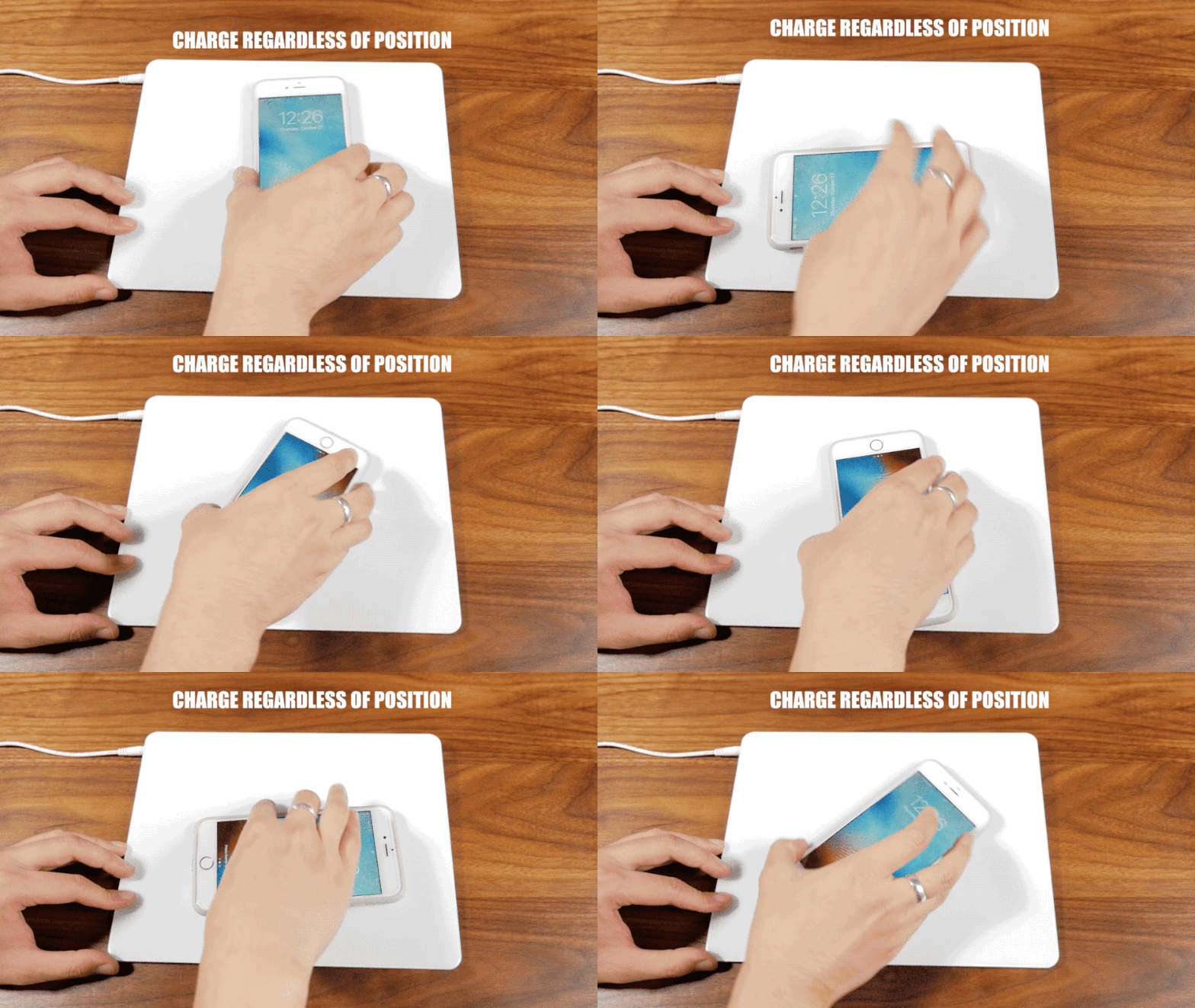
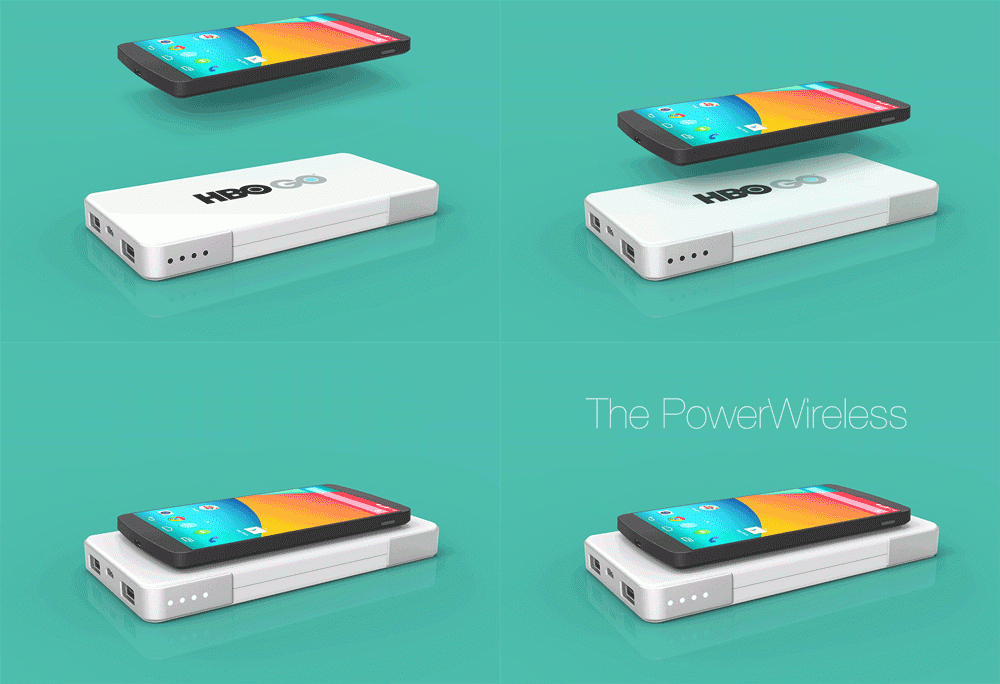
Inductive charging (also known as wireless charging or cordless charging) uses an electromagnetic field to transfer energy between two objects through electromagnetic induction. This is usually done with a charging station. Energy is sent through an inductive coupling to an electrical device, which can then use that energy to charge batteries or run the device.
Induction chargers use an induction coil to create an alternating electromagnetic field from within a charging base, and a second induction coil in the portable device takes power from the electromagnetic field and converts it back into electric current to charge the battery. The two induction coils in proximity combine to form an electrical transformer. Greater distances between sender and receiver coils can be achieved when the inductive charging system uses resonant inductive coupling.
Recent improvements to this resonant system include using a movable transmission coil (i.e., mounted on an elevating platform or arm) and the use of other materials for the receiver coil made of silver plated copper or sometimes aluminium to minimize weight and decrease resistance due to the skin effect.

Advantages
·         Protected connections – No corrosion when the electronics are enclosed, away from water or oxygen in the atmosphere. Less risk of electrical faults such as short circuit due to insulation failure, especially where connections are made or broken frequently.
·         Low infection risk – For embedded medical devices, transmission of power via a magnetic field passing through the skin avoids the infection risks associated with wires penetrating the skin.
·         Durability – Without the need to constantly plug and unplug the device, there is significantly less wear and tear on the socket of the device and the attaching cable.
·         Increased convenience and aesthetic quality – No need for cables.
·         Automated high power inductive charging of electric vehicles allows for more frequent charging events and consequential driving range extension.
·         Inductive charging systems can be operated automatically without dependence on people to plug and unplug. This results in higher reliability.
·         Autonomous driving technology, when applied to electric vehicles, depends on autonomous electric charging. Automatic operation of inductive charging solves this problem, allowing the vehicle to theoretically run indefinitely.
·         Inductive charging of electric vehicles at high power levels enables charging of electric vehicles while in motion (also known as dynamic charging).

Disadvantages
The following disadvantages have been noted for low power (i.e., less than 100 watts) inductive charging devices. These disadvantages may not be applicable to high power (i.e. greater than 5 kilowatts) electric vehicle inductive charging systems.
·         Slower charging – Due to the lower efficiency, devices take 15 percent longer to charge when supplied power is the same amount.
·         More expensive – Inductive charging also requires drive electronics and coils in both device and charger, increasing the complexity and cost of manufacturing.
·         Inconvenience – When a mobile device is connected to a cable, it can be moved around (albeit in a limited range) and operated while charging. In most implementations of inductive charging, the mobile device must be left on a pad to charge, and thus can't be moved around or easily operated while charging. With some standards, charging can be maintained at a distance, but only with nothing present in between the transmitter and receiver.
·         Compatible standards – Not all devices are compatible with different inductive chargers. However, some devices have started to support multiple standards.
·         Inefficiency – Inductive charging is not as efficient as direct charging. In one application, the phone being charged gets hot. Continued exposure to heat can result in battery damage.
Newer approaches reduce transfer losses through the use of ultra thin coils, higher frequencies, and optimized drive electronics. This results in more efficient and compact chargers and receivers, facilitating their integration into mobile devices or batteries with minimal changes required These technologies provide charging times comparable to wired approaches, and they are rapidly finding their way into mobile devices.
For example, the Magne Charge vehicle recharger system employs high-frequency induction to deliver high power at an efficiency of 86% (6.6 kW power delivery from a 7.68 kW power draw).


e-SIM


      Revolution in the mobile industries
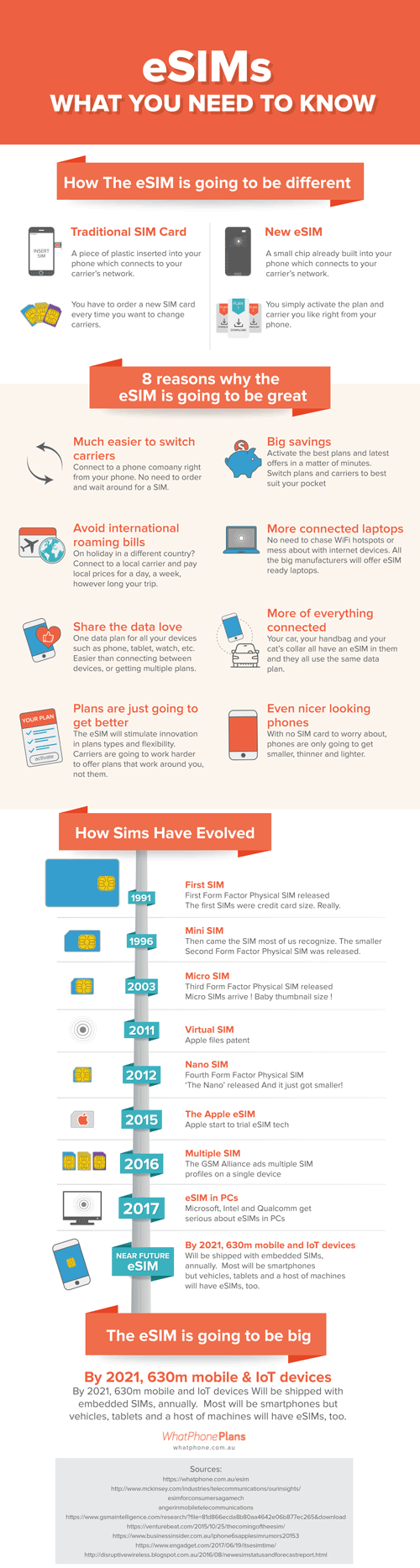
The way you choose a phone company is going to change. The cause ? A seemingly innocuous piece of new technology – the  ‘eSIM‘. So what is an eSIM and how does it work ?
·         An eSIM is an ’embedded’ or ‘electronic’ SIM card which is built into a mobile phone, smartphone or tablet device at the point of manufacture.
·         eSIMs ( a type of ‘soft SIM’ will empower consumers with the freedom to move between mobile phone carriers much more easily.
·         They will make is easier and cheaper to choose the SIM Only or prepaid plans which best suit them.
·         eSIMs have been trialed overseas in Apple iPads and Samsung Galaxy Gear watches.
·         Some say that the new iPhone could contain an eSIM.
·          
·         What is an eSIM?
·         The eSIM is the new standard for SIMs which, when released globally, will eventually become commonplace. The eSIM willl be a replacement for the standard physical SIM you have been using the whole of your life. The title ‘eSIM’ means ’embedded’ or ‘electronic’ SIM.
·         eSIMs will be built in to new smartphones before you buy them but they’ll perform all the same tasks that your SIM ( and it’s housing ) does in your phone right now.
·        

13 mobile accessories you need


We all know our smartphones have changed the way we travel. From booking hotels and flights, finding directions, taking pictures among others, it’s a gadget that travelers would have a difficult time traveling without.
Before you go on your next adventure, make sure you pack the following best accessories for your smartphone for your next travels!

1. Smartphone case
There’s nothing worse than dropping a phone and picking it up with a cracked screen! I always get nervous whenever I see somebody walking (or running to their gates) around the airport without a case on their phone.
Get a case and prevent any bumps and drops on your smartphone!


2. Screen protectors

A screen protector is a sheet of clear plastic that adheres to your smartphone’s screen. If you aren’t willing to invest on a smartphone case, this is your next best alternative to prevent any cracks from dropping your phone!

3. Waterproof case

Prevent disaster on the pool or at the beach with a waterproof case for your smartphone. I like the pouch dry bags because it wraps are your neck and it gives you plenty of space to stash other things on there (cash and cards, for example).


4. Cable Chargers

Cable chargers may not be the most exciting tech gadget on this list, but it is the most essential in order to keep your smartphone running.
Regardless, the durability and design of cable chargers for your smartphones are improving with each passing year. The materials that they come in are available in stainless steel, braided nylon, and even gold plating.


5. Powerbanks
We often find ourselves while traveling that our phone is quickly out of power – and our day has barely started! Taking endless amount of pictures and videos may have something to do with it.
But having a portable powerbank for your smartphone will ensure that your phone is fully charged to capture more pictures and videos.

6. Wall Chargers

Traveling through an airport looking for an outlet, only to find all are taken? A multiport USB charger may save you from running out of juice before boarding your flight.
Anker PowerPort consistently consistently has great reviews.


7. Selfie stick


Embrace the selfie sticks, they are here to stay. They have evolved throughout the years, which speaks to their growing popularity (and acceptance) since the social media selfie movement started a few years back.
Now, they come in compact sizes, variety of add-ons, Bluetooth capable or waterproof – the list goes on.

8. Handheld video stabilizer


If you document your travels by taking lots of videos, a handheld video stabilizer is a must have travel accessory for your smartphone. This gadget provides smooth and steady filming, preventing shake-free videos.

9. Smartphone camera lenses


Embrace the selfie sticks, they are here to stay. They have evolved throughout the years, which speaks to their growing popularity (and acceptance) since the social media selfie movement started a few years back.
Now, they come in compact sizes, variety of add-ons, Bluetooth capable or waterproof – the list goes on. Selfie-sticks arguably is one of the best travel accessory for your smartphone today.


10. Selfie flash light


Take good lighting with you everywhere!  Many of these portable smartphone LED flash light easily attaches to your phone and very easy to us


11. A speaker that charges your smartphone


What’s the use of a portable wireless Bluetooth to play music if your phone has no juice? Thankfully, there are portable Bluetooth speakers that also doubles up as a smartphone charger!
JBL has portable speakers that are waterproof. They have great reviews also


12. Car mounts


For those who will be doing road trips, having a car mount for your smartphone is paramount to making your trip smooth and hassle free. This is especially true when you are driving on a foreign land!


13. Car chargers


Imagine driving on a foreign land without knowing the direction where you are heading because your smartphone is out of battery!
It’s a must have smartphone accessory for any road-trippers!


BATTERY TECHNOLOGY


lithium-ion battery or Li-ion battery (abbreviated as LIB) is a type of rechargeable battery in which lithium ions move from the negative electrode to the positive electrode during discharge and back when charging. Li-ion batteries use an intercalated lithium compound as one electrode material, compared to the metallic lithium used in a non-rechargeable lithium battery. The electrolyte, which allows for ionic movement, and the two electrodes are the constituent components of a lithium-ion battery cell.
Lithium-ion batteries are common in home electronics. They are one of the most popular types of rechargeable batteries for portable electronics, with a high energy density, tiny memory effect and low self-discharge. LIBs are also growing in popularity for military, battery electric vehicle and aerospace applications.
Lithium-ion batteries can pose unique safety hazards since they contain a flammable electrolyte and may be kept pressurized. A battery cell charged too quickly could cause a short circuit, leading to explosions and fires. Because of these risks, testing standards are more stringent than those for acid-electrolyte batteries, requiring both a broader range of test conditions and additional battery-specific tests. There have been battery-related recalls by some companies, including the 2016 Samsung Galaxy Note 7 recall for battery fires.
Research areas for lithium-ion batteries include life extension, energy density, safety, cost reduction, and charging speed, among others. Research has also been under way for aqueous lithium-ion batteries, which have demonstrated fewer potential safety hazards due to their use of liquid electrolytes.
Most modern mobile devices use lithium ion (sometimes called Li-ion) batteries, which consist of two main parts: a pair of electrodes and the electrolyte between them. The materials that these electrodes are made of varies (they can be lithium, graphite, or even nanowires), but they all rely on the chemistry of lithium. It's a reactive metal, which means that it has a tendency to combine with other elements. Pure lithium is so reactive, it can catch fire in the air, so most batteries use a safer form called lithium cobalt oxide. Between the two electrodes is the electrolyte, which is usually a liquid organic solvent that allows electrons to flow between them. When a lithium ion battery is charged, the lithium cobalt oxide molecules capture and hold electrons, which they then release when the battery is in use, such as when it is running your cell phone.

Battery capacity
The capacity of a battery is measured in milliampere-hours (or mAh), which indicates how much energy the battery can deliver over time. For instance, if a battery has a rating of 1000 mAh, it could deliver 1000 milliamps of power for 1 hour. If your device uses 500 milliamps of power, the battery should last about 2 hours.
The battery life of a device is a bit more complicated than that, though, as the amount of power a device uses changes depending on what it is doing. If the device's screen is on, the radio is transmitting, and the processor is working hard, it will use more energy than if the screen is off and the radio and processor are idle.
Controlling the flow of power
Battery makers accomplish that by building in a charge controller that manages the flow of electricity. In effect, every battery has a small computer inside it that prevents it from being discharged too fast, or to a dangerously low level. This component also regulates the flow of power into the battery during charging, slowing the flow of power as the battery gets close to being fully charged to prevent overcharging.


The future of power

Battery technology is always improving, with labs around the world looking for new battery technologies to replace lithium as well as new approaches to building lithium ion batteries. Among the new technologies, a lot of work has gone into supercapacitors, in which the battery stores energy electrically and then releases it, like a flash gun. Supercapacitors could allow for much quicker charging, as little chemical change is involved, but current supercapacitors can deliver power only in short bursts, which is the opposite of what most mobile devices need. Fuel cells that use hydrogen to generate electricity are also coming soon. The Nectar fuel-cell system, announced at the CES trade show in January, uses a $10 cartridge to power a cell phone for up to two weeks. However, fuel cells are not yet small enough to fit inside a phone—the Nectar system charges the existing lithium ion battery and doesn't replace it.
Safety
If overheated or overcharged, Li-ion batteries may suffer thermal runaway and cell rupture.[174] In extreme cases this can lead to leakage, explosion or fire. To reduce these risks, many lithium-ion cells (and battery packs) contain fail-safe circuitry that disconnects the battery when its voltage is outside the safe range of 3–4.2 V per cell. or when overcharged or discharged. Lithium battery packs, whether constructed by a vendor or the end-user, without effective battery management circuits are susceptible to these issues. Poorly designed or implemented battery management circuits also may cause problems; it is difficult to be certain that any particular battery management circuitry is properly implemented. Lithium-ion cells are susceptible to damage outside the allowed voltage range that is typically 2.5 to 3.65 V for most LFP cells. Exceeding this voltage range, even by small voltages (millivolts) results in premature aging of the cells and, furthermore, results in safety risks due to the reactive components in the cells. When stored for long periods the small current draw of the protection circuitry may drain the battery below its shutoff voltage; normal chargers may then be useless since the BMS may retain a record of this battery (or charger) 'failure'. Many types of lithium-ion cells cannot be charged safely below 0 °C.
Other safety features are required in each cell:
·         Shut-down separator (for overheating)
·         Tear-away tab (for internal pressure relief)
·         Vent (pressure relief in case of severe outgassing)
·         Thermal interrupt (overcurrent/overcharging/environmental exposure)
These features are required because the negative electrode produces heat during use, while the positive electrode may produce oxygen. However, these additional devices occupy space inside the cells, add points of failure, and may irreversibly disable the cell when activated. Further, these features increase costs compared to nickel metal hydride batteries, which require only a hydrogen/oxygen recombination device and a back-up pressure valve. Contaminants inside the cells can defeat these safety devices. Also, these features cannot be applied to all kinds of cells, e.g. prismatic high current cells cannot be equipped with a vent or thermal interrupt. High current cells must not produce excessive heat or oxygen, lest there be a failure, possibly violent. Instead, they must be equipped with internal thermal fuses which act before the anode and cathode reach their thermal limits.
There are four basic types of rechargeable battery used in mobile phones:

1.   Nickel Cadmium (NiCd) Batteries
Nickel Cadmium cell phone batteries are based on old technology.  The chemicals used in NiCd batteries are not environmentally friendly, and the disposal of cadmium-rich waste is an increasing problem. They are the cheapest variety of phone batteries. Their affordablility helps to bring down the overall cost of mobile phones.
2.   Nickel Metal Hydride (NiMH) Batteries
Nickel Metal Hydride (NiMH) batteries claim to be superior to NiCd because they don’t contain cadmium. The cell phone batteries are made from non-toxic materials and are environmentally friendly. They also deliver a higher capacity in relation to their size and weight.
3.   Lithium Ion (Li-Ion) Batteries
This is the current and most popular technology for cell phone batteries. The only real drawback of Lithium Ion cell phone batteries is that they are expensive. As such, they tend to be supplied with only top-of-the-line phones. Lithium Ion batteries are slightly lighter than NiMH batteries, but they also have a longer lifetime. A Lithium Ion battery may be damaged by extensive overcharging (continuously on a cell phone charger for more than 24 hours).
4.   Lithium Polymer (Li-Poly) Batteries
Li-Poly Batteries are the newest and most advanced technology for cell phone batteries. Ultra-lightweight, they do not suffer from memory effect and will deliver up to 40% more battery capacity than a Nickel Metal Hydride (NiMH) of the same size.
Conclusion
Li-ion batteries and cells or li-ion batteries and cells are now in widespread use. They have taken a position of dominance in the rechargeable battery market and as a result many mobile phones, laptop computers and cameras, etc use them. Although there are many new battery developments taking place, lithium ion batteries, li-ion batteries will remain one of the main types of battery for many years to come. Lithium Ion and Lithium Ion Polymer batteries are a great power source for projects but they require care during use and charging. They can be easy to damage or misuse and can hurt you or your property! All the batteries are sell pass testing and certification but you should still be careful with them.

BY:- TARLOCHAN BHIKHA